

Real Estate Transaction Tax in Saudi Arabia 2026
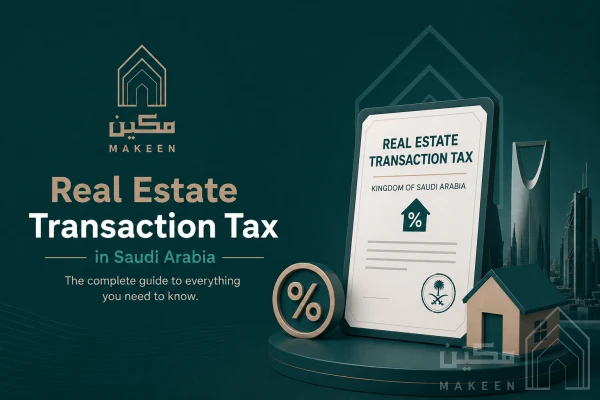
real estate transaction tax : It is charged at 5% of the full deal value, and on a mid-range Riyadh apartment that can mean tens of thousands of riyals.
At Asas Makeen, we are a licensed real estate developer in Riyadh handling title transfers for hundreds of residential units each year. Three questions come up in almost every conversation: how much is it, who pays it, and am I exempt?
This guide answers all three, based on the Real Estate Transaction Tax Law and its Implementing Regulations currently in force.
What is the real estate transaction tax?
The real estate transaction tax (RETT) is an indirect tax levied at 5% on any legal disposal that transfers ownership or possession of a property for the purpose of ownership, regardless of the property's condition, form, or use.
The definition covers land and anything built on it. Vacant plots, finished apartments, villas, commercial buildings, and units still under construction all fall within scope.
The real estate transaction tax was introduced in October 2020 under Royal Order No. (A/84), at the same time real estate supplies were carved out of the 15% Value Added Tax. The intent was to reduce the burden on buyers: instead of 15%, property became subject to 5%.
On 22 September 2024, Royal Decree No. (M/84) approved the Real Estate Transaction Tax Law as a standalone framework. The law and its 15-article Implementing Regulations took effect on 10 April 2025, and all related transactions became fully electronic from 15 April 2025.
RETT versus VAT
Confusing the two is common, and the difference matters:
Rate: 5% for the real estate transaction tax against 15% for VAT.
Nature: The real estate transaction tax is a one-off charge on the disposal event, while VAT is cumulative across the supply chain.
Input recovery: Real estate transaction tax inputs are not recoverable. Input VAT is.
Scope: RETT applies to the transfer of property ownership or possession for ownership purposes. VAT applies to goods and services generally.
Authority: ZATCA administers both.
Residential and commercial property sales are excluded from VAT and instead subject to the real estate transaction tax. Residential leases are exempt from both, while commercial leases remain subject to VAT.
Real estate transaction tax rate and how it is calculated
The real estate transaction tax rate is fixed at 5% of the total value of the disposal as agreed between the parties.
The formula is straightforward:
Tax due = Property price × 5%
There is an important qualification in the Implementing Regulations. The value used is the consideration agreed between the parties — cash or in kind — provided it falls within fair market value. If ZATCA determines the recorded price is below fair market value, it may reassess and recalculate the real estate transaction tax on the fair value instead.
Permits and any principal or ancillary real rights so closely tied to the property that they cannot be treated as separate also form part of the total value.
Worked examples
A property at SAR 600,000 carries SAR 30,000 in tax, fully covered by the state if it is a citizen's first home.
A property at SAR 850,000 carries SAR 42,500, again fully covered in the same case.
A property at SAR 1,000,000 carries SAR 50,000, which is the ceiling of state coverage.
A property at SAR 1,500,000 carries SAR 75,000. The state covers 50,000 and the buyer pays 25,000.
A property at SAR 2,400,000 carries SAR 120,000. The state covers 50,000 and the buyer pays 70,000.
A commercial property at SAR 5,000,000 carries SAR 250,000 with no exemption, since first home relief applies only to a citizen's residential purchase.
Practical note: budget for the real estate transaction tax before you sign, not after. Five percent on a SAR 1.5 million apartment is SAR 75,000 — enough to stall a completed negotiation. Also be aware that banks generally finance the property value, not the real estate transaction tax, so plan to pay it from your own liquidity.
Who pays the real estate transaction tax, buyer or seller?
Under the law, the seller (the disposer) is directly liable to ZATCA for settling the real estate transaction tax before or during the title transfer.
In practice, things look different. The law allows the parties to agree that the buyer will bear the cost, and this is now common in the Saudi market. That private agreement does not shift statutory liability: if the tax goes unpaid, ZATCA pursues the seller.
Many owners currently pass the cost on indirectly by raising their asking price. So:
- If you are buying: ask directly, before negotiating, whether the quoted price includes the real estate transaction tax — then put the answer in the contract.
- If you are selling: do not accept an arrangement placing the tax on the buyer without a clause obliging payment ahead of the transfer date.
Buying from a licensed developer simplifies this, because the developer handles the line item on every deal. In our projects, the tax position is stated in the price offer from the outset.
Which disposals are taxable
ZATCA has identified seven principal categories subject to the real estate transaction tax:
- Documented property sales before a notary or an authorised documenter
- Lease-to-own contracts
- Finance lease contracts
- Long-term usufruct contracts exceeding 50 years
- Property sold at public auction where documented
- Waiver or assignment of usufruct rights
- Off-plan property sales
Exchange and barter contracts, gifts outside the exempt categories, and transfers of shares in real estate companies under defined controls are also captured.
A point many people miss: the tax is due once per disposal. If you buy a property and pay the tax, then sell it later, the second sale is a new, separate taxable event. That is not double taxation — it is the system working as designed, and it is a real factor when modelling returns on any real estate investment in Riyadh.
Real estate transaction tax exemptions
The Implementing Regulations widened exemptions for economic and social purposes. The main categories:
- Division or distribution of an estate, carried out under applicable Saudi law.
- Disposal under a documented will, where the will is duly documented.
- A gift to a spouse or a relative up to the third degree, where the gift is documented, subject to a three-year re-disposal restriction.
- Public, private or joint endowments (waqf), registered with and supervised by the endowment authorities and made without consideration.
- Expropriation for public benefit or temporary seizure, carried out under the law, including the return of the property to its original owner.
- Disposal to a licensed off-plan developer, where the developer holds a valid licence on the disposal date.
- Public offering of shares in a real estate company, under the Capital Market Law.
- Trading listed securities of a real estate company on a licensed exchange.
- Trading unlisted units of a fund established in the Kingdom, within defined controls.
- Disposal by a government body acting as a public authority, outside economic, investment or commercial activity.
Important caveat: exemptions are not automatic. You must disclose the disposal and provide supporting evidence through ZATCA's portal. Breaching an exemption condition later revives the real estate transaction tax liability from the date of breach, with the payment window running from that date.
For gifts specifically, the exemption does not apply if the recipient re-disposes of the property within three years to someone who would not have qualified had they received it directly from the original donor. That clause exists to close an avoidance route.
The first home exemption up to SAR 1 million
This is the exemption that matters most to citizens buying a home, and the most searched question around the real estate transaction tax.
Under a government initiative, the state bears the tax on behalf of a Saudi citizen purchasing their first home, capped at SAR 1 million of the property value — a maximum of SAR 50,000. Where the price exceeds SAR 1 million, the citizen pays 5% on the excess only.
Example: a home priced at SAR 1,400,000. The state covers the tax on the first million (SAR 50,000), and the buyer pays 5% on the remaining SAR 400,000 = SAR 20,000.
Eligibility conditions
- The buyer must be a Saudi citizen
- No residential property may be registered in their name, verified through the real estate registry
- The property must be residential and ready or fit for habitation
- It must be the buyer's first and only home
Obtaining the exemption certificate
- Log in to the Sakani platform or the Ministry of Municipalities and Housing portal
- Select the "Your First Home Without Tax" service
- Enter beneficiary and property details
- Download the certificate issued after eligibility verification
- Submit it as part of the disclosure process with ZATCA
The certificate is linked electronically to ZATCA's portal, and the deduction applies automatically during electronic title transfer. If the real estate transaction tax was paid despite eligibility, a refund request can be filed with the first home certificate, a copy of the title deed, the payment invoice, and a bank account number.
If you are planning your first purchase, our housing support calculator for Saudi Arabia and our guide to the difference between housing support and an unsubsidised mortgage will help complete the financial picture.
How to register and pay
Since 15 April 2025, every step is electronic. Paper or manual registration is no longer accepted.
The sequence:
- Access the ZATCA portal and open the Real Estate Transactions service
- Submit a disposal registration request with seller, buyer, and property details (deed number, location, area, value)
- Declare any exemption and attach supporting documents
- Generate the payment invoice with a SADAD number
- Pay through approved banking channels
- Complete the title transfer before a notary or authorised documenter
A hard rule: no disposal is documented and no transfer completes until the tax is paid or the exemption is evidenced. ZATCA and the Ministry of Justice are linked electronically, and there is no way around this step.
Timing
- Payment is due within 30 days of the disposal date, or of the date an exemption condition is breached
- Where possession transfers for ownership purposes, the disposal date is the date the property is placed in the transferee's possession
- For usufruct exceeding 50 years, it is the grant date, unless the grant is cancelled within 30 days
- ZATCA may verify a disposal for three years from the date it was documented
Real estate transaction tax penalties
The new real estate transaction tax law reduced the late payment penalty from 5% to 2% per month or part thereof of the unpaid amount. This is one of the more significant changes the 2025 framework introduced.
Late payment attracts 2% of the unpaid amount for each month of delay or part thereof.
Failure to disclose, inaccurate disclosure, or an understated property value attracts a penalty of not less than SAR 10,000 and not more than the tax due.
Tax evasion attracts a penalty of not less than the tax due and up to three times that amount.
Assisting or facilitating evasion carries the same penalty as evasion itself, and applies to anyone proven to have taken part.
Recording a price below the true value in the deed is classified as a sham disposal and treated as evasion. The penalty extends beyond the seller to anyone proven to have participated in, assisted, or facilitated the evasion — including the broker.
With government entities linked electronically, and ZATCA empowered to use third-party data to assess fair market value, understating a recorded price is an unquantified risk rather than a saving.
Off-plan purchases and the real estate transaction tax
Off-plan deals get specific treatment worth understanding.
A disposal by any person to a licensed off-plan developer is exempt from the real estate transaction tax, provided the developer holds a valid licence on the disposal date. The exemption is designed to encourage landowners to bring plots into the development cycle.
The onward sale of an off-plan unit to the end buyer, however, is taxable. The Regulations do permit deferred payment in defined cases, including where a disposal later proves not to have qualified for an expected exemption in off-plan scenarios.
What this means for you: when buying an off-plan apartment, ask the developer for a written explanation of when the tax falls due and which party bears it, since the transfer happens later on project completion.
Deal only with developers licensed by the Real Estate General Authority and registered on the Wafi platform. Licensing here is not a formality — it determines your tax and legal position.
Foreign buyers and the new ownership framework
The Non-Saudi Real Estate Ownership Law came into force in January 2026, opening defined zones — Riyadh among them — to ownership by non-Saudi individuals and entities, subject to eligibility screening and registration through the official portal.
For international buyers, two points are worth flagging:
- The first home exemption does not apply. It is reserved for Saudi citizens, so non-Saudi purchasers face the full 5% charge.
- The real estate transaction tax sits alongside other costs in the new framework, including registration requirements and fees tied to non-Saudi ownership, which should be modelled together rather than separately.
Because this framework is recent and details are still settling into practice, verify current requirements with the Real Estate General Authority before committing capital. Riyadh's residential market has attracted significant international interest since the law took effect, and the cost stack for a foreign buyer differs meaningfully from that of a citizen purchasing a first home.
Five costly mistakes
From our day-to-day experience with title transfers in Riyadh, these recur most often:
1. Budgeting without the real estate transaction tax. Buyers set a ceiling on the property price alone, then meet an additional 5% at transfer. The result is a delayed deal or emergency borrowing.
2. Assuming the exemption applies automatically. The first home exemption requires a certificate issued in advance. Paying first and claiming a refund later means an administrative cycle that was entirely avoidable.
3. Relying on a verbal agreement about who pays. One contract clause settles it. Without it, you negotiate at the worst possible moment — the transfer appointment.
4. Agreeing to understate the deed value. It is sometimes presented as a saving. In reality it exposes both parties to a penalty of up to three times the tax, plus reassessment powers for three years.
5. Not verifying the seller's or developer's licence. Licensing determines the tax treatment of the deal, particularly off-plan. Checking takes minutes.
Before comparing options, see our guide to apartments for sale in Riyadh.
Frequently asked questions
Does the real estate transaction tax apply to vacant land?
Yes. Land and anything built on it fall within scope. Buying a plot for the first time does not create an automatic exemption, because the first home relief is tied to a habitable dwelling.
Are leases taxable?
Ordinary leases are not. Lease-to-own, finance leases, and usufruct contracts exceeding 50 years are.
Can the real estate transaction tax be refunded if paid in error? Yes, through a refund request to ZATCA with supporting documents. ZATCA may offset or withhold the refund against other outstanding liabilities.
Do expatriates qualify for the first home exemption?
No. It is reserved for Saudi citizens. Non-Saudis pay the full real estate transaction tax on acquisition under the applicable ownership rules.
How does this differ from the White Land Tax?
The real estate transaction tax is triggered by a transfer of ownership. The White Land Tax is a recurring annual levy on undeveloped land inside urban boundaries, intended to push it into development.
Is the real estate transaction tax based on the recorded price or market value?
On the agreed price, provided it is not below fair market value. ZATCA may reassess within three years of documentation.
Will a bank finance the tax as part of the mortgage?
Usually not. Banks finance the property value, not associated fees and taxes. Plan to cover it from your own funds alongside the down payment, valuation, registration, and insurance costs.
Does the rate differ between residential and commercial property? No. The 5% rate is uniform. Only the exemptions differ, with first home relief tied to a citizen's residential purchase.
Before you sign
The real estate transaction tax is not a procedural detail. It is a 5% line item that belongs in your cost sheet from day one, next to valuation, registration, and insurance fees.
A quick checklist:
- Calculate 5% on the final price and add it to your budget
- Agree in writing which party bears the tax
- Check first home eligibility before signing
- Obtain the exemption certificate if you qualify
- Confirm the seller or developer is licensed and registered
- Never accept an understated deed value, whatever the justification
At Asas Makeen, we handle this line item transparently in every offer. Our sales team sets out the tax position and available exemptions for each unit before any contract is signed.
Browse our projects available for sale in Riyadh or contact us to discuss the right fit.
Disclaimer: This content is for general awareness and reflects the published Real Estate Transaction Tax Law and its Implementing Regulations. Regulations change and details vary by case. Consult ZATCA's official website or a qualified adviser before making any decision.