


Mortgage Calculator Saudi Arabia 2026
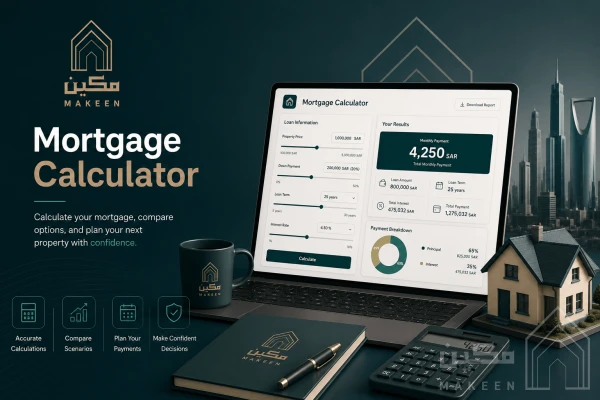
The first question anyone considering a home purchase asks is not "what does this apartment cost?" but "what can I afford each month?" The difference between those two questions is the difference between a wish and a financial decision you can act on.
A mortgage calculator turns your salary into three clear numbers: the maximum financing available to you, the monthly instalment attached to it, and the down payment you need in cash.
At Asas Makeen, we deal daily with buyers who arrive having already chosen a unit, only to discover the numbers do not work. This guide explains how the calculation works, how to read the result properly, and what it does not tell you.
Mortgage Calculator
Results are indicative, for planning only, and do not constitute an offer or credit approval. Ratios are set by the Saudi Central Bank and may change; actual terms depend on each lender’s credit policy. Ancillary costs exclude the real estate transaction tax where it applies to you.
What a mortgage calculator does
A mortgage calculator is an estimation tool that converts your income and the property price into three figures: the monthly instalment, the total amount payable over the term, and the cost of term — the profit you pay above the principal.
The mortgage calculator does not issue an approval and does not replace the lender's credit assessment. What it does is apply a mathematical formula to the inputs you give it, producing a realistic picture before you submit a formal application.
Its real value lies in reversing your order of operations. Instead of finding a property and then asking whether you can finance it, you start from the number your budget supports and search within it.
Why do calculators disagree?
Try three different tools and you may get three different answers. That is not an error in any of them, but a difference in assumptions:
- Some calculate on net salary, others on gross salary
- Some assume a 55% debt burden ratio, others 65%
- Some use reducing-balance profit, others flat-rate
- Some add insurance and administrative fees, others ignore them
So never compare one mortgage calculator result against a number from elsewhere without knowing what each one assumed.
The inputs a mortgage calculator needs
Every mortgage calculator needs at least five inputs:
Monthly income. Basic salary plus fixed allowances. Variable allowances and annual bonuses are usually excluded.
Existing monthly obligations. Personal loan instalments, credit cards, car finance. Every existing commitment directly reduces your borrowing capacity.
Property price. The market value or the agreed price.
Financing term. Typically 5 to 25 years for individuals, and up to 30 years on some Sharia-compliant products.
Profit rate. The annual percentage rate (APR) the lender is offering.
The more accurate your inputs, the closer the mortgage calculator result will be to reality. Entering an inflated salary or omitting an existing commitment gives you a comfortable number on screen and an unpleasant surprise at the bank.
How maximum financing is derived from your salary
This is the most important step in any mortgage calculator, and it rests on the debt burden ratio (DBR).
The DBR is the maximum share of your monthly income a lender may commit to servicing debt. The Saudi Central Bank (SAMA) regulates these limits under its Responsible Lending Principles to protect borrowers from default.
The current picture, simplified:
For ordinary consumer finance, the ceiling is 33.33% of an employee's gross salary and 25% for a retiree.
Real estate finance is treated differently, because it funds an asset the customer retains. Total monthly obligations including the housing instalment may reach 65% for some income brackets, while the ratio was reduced to 55% for employees earning under SAR 15,000 as part of a move to ease pressure on middle-income borrowers.
The exact figure depends on your income bracket, whether you receive housing support, and the lender's own credit policy. This is why a mortgage calculator gives you an estimate rather than a commitment.
The formula:
Maximum monthly instalment = Monthly income × DBR − existing obligations
The mortgage calculator then reverses the equation, working back from the instalment to the total financing it supports over your chosen term.
Example: a SAR 12,000 salary with no existing obligations at a 55% DBR gives a maximum instalment of SAR 6,600. Over 25 years at a 5.5% APR, that translates to financing of roughly SAR 1,075,000 — before the down payment is added.
Loan-to-value and the down payment
Lenders do not finance 100% of a property's value. The remainder is your down payment, paid from your own funds.
Under SAMA's real estate finance rules, the general ceiling on loan-to-value is 70% of the value of the dwelling under the contract. That ceiling is raised by exception to 85%, and to 90% for a citizen purchasing their first home, under a decision issued in January 2018.
In practice:
A SAR 1 million property at 90% LTV: financing of SAR 900,000 and a down payment of SAR 100,000.
The same property at 70% LTV: financing of SAR 700,000 and a down payment of SAR 300,000.
That is a SAR 200,000 swing out of your own pocket. So the first thing to establish before running any mortgage calculator is whether you qualify as a first-home buyer.
For the support pathways available, see our housing support calculator for Saudi Arabia.
The mortgage calculator instalment formula
Most tools use the reducing-balance amortisation formula:
Instalment = P × [ r(1+r)^n ] ÷ [ (1+r)^n − 1 ]
Where r is the annual profit rate divided by 12 and n is the number of months.
What matters is understanding the logic rather than memorising it. Early on, the larger share of each instalment goes to profit and the smaller share to principal. Over the years that ratio gradually inverts.
This explains why your outstanding balance barely moves during the first five years despite consistent payments — a fact that surprises many buyers, and one a mortgage calculator will not reveal unless it shows the full amortisation schedule.
Fixed versus variable profit
Fixed profit (Murabaha): the instalment never changes. You know your commitment precisely from day one, but you gain nothing if market rates fall.
Variable profit: linked to SAIBOR, so the instalment rises and falls with it. Usually cheaper at signing, but it carries risk across a twenty-year horizon.
When using a mortgage calculator with a variable product, run a second scenario assuming the rate rises by two percentage points, then ask yourself whether you could absorb the new instalment. If the answer is no, the fixed product suits you better even if it looks more expensive today.
Mortgage calculator worked examples
Case one — SAR 10,000 salary. At a 55% DBR the maximum instalment is SAR 5,500. Over 25 years at 5.5% that supports financing near SAR 895,000. At 90% LTV, the property price ceiling is roughly SAR 995,000, with a down payment around SAR 99,500.
Case two — SAR 20,000 salary. A higher income bracket permits a larger DBR, so the mortgage calculator returns a materially different ceiling. The maximum instalment may reach SAR 13,000, supporting financing near SAR 2,115,000 over 25 years at the same rate.
Case three — SAR 10,000 salary with an existing SAR 2,000 commitment. The maximum instalment drops from SAR 5,500 to SAR 3,500, and financing from SAR 895,000 to SAR 570,000. Borrowing capacity shrinks by more than a third because of a single car payment.
The lesson from case three: clear small commitments before applying. Their effect on a mortgage calculator result is far larger than most people expect.
The amortisation schedule
The most useful thing you can request alongside any mortgage calculator output is the amortisation schedule — the table breaking each instalment into principal and cost of term.
Take SAR 900,000 over 25 years. In year one, close to two-thirds of each instalment may go to profit and only a third to principal. By year fifteen the balance shifts, and in the final years most of the instalment repays principal.
Why this matters, practically:
First, if you plan to sell after five years, your outstanding balance will be far higher than you expect. Model this before buying with a short resale horizon in mind.
Second, any extra payment made early removes cumulative cost of term across every remaining year. A single SAR 50,000 payment in year three can save several times that over the contract.
Third, understanding the schedule stops you from feeling discouraged when your balance has barely moved after three years of disciplined payments. That is the formula behaving normally, not an error.
Term length: 15 versus 20 versus 25 years
Extending the term is the easiest way to reduce the instalment, and the most expensive decision long-term. Run the mortgage calculator across all three before committing.
On SAR 900,000 at a mid-range profit rate, the approximate picture:
15 years: an instalment of SAR 7,354 and total cost of term of SAR 424,000. The highest payment and by far the lowest cost. Suited to stable, higher incomes.
20 years: an instalment of SAR 6,191 and cost of term of SAR 586,000. The balance point many buyers choose.
25 years: an instalment of SAR 5,527 and cost of term of SAR 758,000. The lowest payment and highest apparent purchasing power, but you pay SAR 334,000 more than the 15-year option to save SAR 1,827 a month.
The practical rule: take the longest term that lets you qualify, then make additional payments whenever liquidity allows. That gives you the flexibility of a low instalment without absorbing the full cost of a long term. Ask about partial early settlement terms before signing, since they vary by product.
One constraint to note: term length is also capped by your age at maturity. If you are in your forties, a 25-year term may simply not be available — a limit no general mortgage calculator knows about.
Costs a mortgage calculator does not show
This is where the biggest miscalculations happen. A mortgage calculator works out the instalment, but buying property involves other cash costs paid upfront:
Real estate transaction tax: 5% of the property value. On a SAR 1 million property that is SAR 50,000, though the state bears it for a citizen's first home within a SAR 1 million cap. Full detail in our guide to the real estate transaction tax.
Valuation fees: required by the lender from an accredited valuer.
Administrative fees: a percentage of the financing amount under SAMA's rules.
Property and finance protection insurance: annual premiums that add to your commitment.
Documentation and title transfer costs.
A practical rule: set aside 6% to 8% of the property price for ancillary costs, on top of the down payment. First-home relief reduces this considerably, but planning high is safer.
How to compare three offers properly
Once the mortgage calculator has given you an indicative figure, the next step is requesting formal offers. This is where most buyers compare superficially.
Do not compare on the profit rate. A lender quoting a lower rate but charging higher administrative fees and pricier compulsory insurance may cost more overall.
Compare on four numbers only:
Annual percentage rate (APR). The only fairly comparable indicator, because it combines the profit rate and fees into one figure. SAMA requires lenders to calculate it using uniform rules for precisely this purpose.
Total amount payable. What you will actually pay from first instalment to last. This number exposes differences that rates conceal.
Monthly instalment. Your real commitment against your monthly budget.
Early settlement terms. How the payoff amount is calculated if you finish ahead of schedule.
Request the official disclosure form from each lender — a standardised document showing the financing amount, cost of term, APR, fees, down payment, instalment and total payable. SAMA requires the offer to remain valid for at least 15 business days, with a waiting period of at least 5 business days before signing. Use that window to review and compare line by line.
Six mistakes when using a mortgage calculator
1. Treating the maximum as the target. That a lender will finance SAR 2 million does not make it a sound decision. Leave headroom for income volatility.
2. Ignoring existing obligations. Every live instalment cuts directly into your capacity.
3. Calculating on gross instead of net salary. A difference that can run to hundreds of riyals a month in the result.
4. Comparing offers on the profit rate alone. APR is the correct measure because it captures fees.
5. Forgetting the offer validity window. Use the mandated waiting period rather than signing on the spot.
6. Relying on a single result. Vary the term and the down payment and run the mortgage calculator several times. Extending the term lowers the instalment but raises total cost substantially.
Frequently asked questions
How much financing can I get on a SAR 10,000 salary? Indicatively between SAR 700,000 and SAR 900,000 depending on term, profit rate, existing obligations and whether housing support applies. The final figure comes from the credit assessment.
Can I get financing with no down payment? Not in ordinary circumstances, because SAMA caps loan-to-value. The down payment may fall to 10% for a citizen buying a first home, and support programmes may cover part of it.
Does a mortgage calculator include insurance? Usually not. Ask your lender for the annual premium and add it manually to get your true commitment.
What is the maximum term? Typically 25 years for individuals and up to 30 years on some products, also limited by your age at maturity. Set the term in the mortgage calculator to the shortest one your budget tolerates, then compare the total payable against a longer term before deciding.
Can I combine my spouse's income? Some lenders allow joint financing across two incomes, which lifts the ceiling noticeably. Terms differ by lender and both parties take on joint liability. Ask about this explicitly if a single income falls short.
Does my SIMAH record change the result? It does not change the mortgage calculator arithmetic, but it directly affects the lender's decision and the profit rate offered. A distressed record can mean rejection or a higher rate, and either shifts your real numbers. Review your report before applying.
Can expatriates obtain real estate finance? Some lenders offer products to residents on different terms and lower LTV ratios. Housing support programmes are reserved for citizens.
Why does my mortgage calculator result differ from the bank's? The calculator applies a formula to your inputs. The bank adds a credit assessment covering your SIMAH record, employment stability and the property valuation itself. Expect a gap.
Does early settlement save money? Yes, because it reduces the remaining cost of term. SAMA regulates how the settlement amount is calculated, so ask before signing.
Should I calculate on my current or expected salary? Always the current one. The lender assesses documented income at the time of application, and building on an anticipated raise exposes you to a commitment you cannot carry if it is delayed.
Summary
A mortgage calculator is not a curiosity. It is a mandatory first step before any showroom visit or reservation.
In order:
- Work out the instalment you can genuinely carry, not the maximum the bank permits
- Establish the down payment you have available in cash
- Add 6–8% for ancillary costs
- Check your housing support eligibility before anything else
- Request disclosure forms from three lenders and compare on APR, not the profit rate
- Search for a unit after the mortgage calculator has given you your number, not before
At Asas Makeen, our sales team helps match your financing capacity to units that are actually available, and sets out the full cost picture before any commitment.
Browse our projects available for sale in Riyadh or contact us to discuss what fits your budget.
Disclaimer: This content is for general awareness. We are not a lender or a financial adviser. Results are indicative and do not constitute an offer or credit approval. Ratios and rules are set by the Saudi Central Bank and may change. Consult a licensed financing provider for your actual figures.